
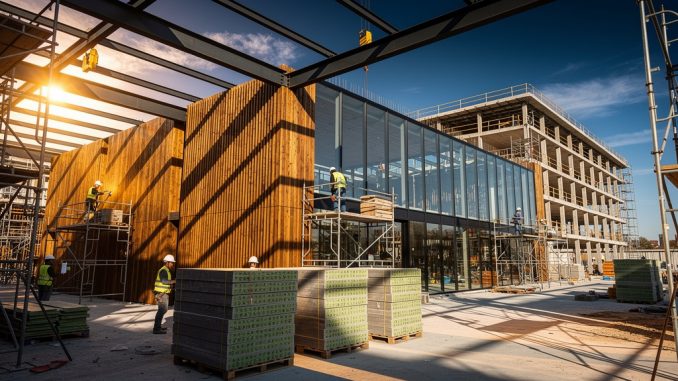
The construction and real estate sectors are undergoing a profound shift. New construction materials and renovation techniques are reshaping how buildings are designed, built, and upgraded across France and beyond. From bio-sourced insulation to digital modeling tools, the industry now offers solutions that were unthinkable two decades ago. The ecological materials market has grown at 11% per year, a figure that reflects a structural change in professional practices rather than a passing trend. Whether you own property, manage a renovation project, or invest in real estate, understanding these developments directly affects your budget, your property’s value, and its energy performance rating — the DPE — which is now central to any transaction or rental agreement in France.
Innovative Materials Transforming the Building Industry
Cross-laminated timber (CLT) has moved well beyond niche status. Engineered from stacked layers of wood glued at perpendicular angles, it delivers structural performance comparable to reinforced concrete while storing carbon rather than emitting it. Major groups like Saint-Gobain have invested heavily in bio-sourced product lines precisely because demand from contractors and private clients has accelerated sharply since 2020.
Hempcrete is another material gaining serious traction. Made from hemp hurds mixed with lime, it provides natural thermal and acoustic insulation, regulates humidity, and is fully biodegradable. Its thermal inertia reduces heating and cooling loads significantly, which translates directly into lower energy bills and a better DPE score for the property.
Recycled concrete and reclaimed aggregates now appear in more specifications than ever. In 2022, 30% of renovation projects in France incorporated recycled materials, according to data tracked by the Syndicat National des Matériaux de Construction. This adoption is not driven purely by environmental conviction — recycled aggregates are increasingly cost-competitive, particularly as virgin material costs rose by an average of 5% in 2023.
Aerogel insulation panels represent the high-performance end of the spectrum. Extremely thin yet highly insulating, they are ideal for urban renovation projects where wall thickness cannot be sacrificed. A single centimeter of aerogel can match the thermal performance of several centimeters of conventional mineral wool. The cost remains elevated, but for listed buildings or tight floor plans, no comparable alternative exists.
Photovoltaic glass, which integrates solar cells directly into glazing, bridges the gap between building envelope and energy production. Lafarge and several European startups now produce facades that generate electricity without any visible panel installation. The technology suits both new builds and ambitious renovation projects on commercial properties.
Modern Renovation Techniques and Their Practical Impact
Thermal renovation has become the dominant category of building work in France, driven by tightening DPE regulations that restrict the rental of the most energy-inefficient properties. The technique of exterior insulation cladding (ITE) involves wrapping the building envelope in insulating panels before applying a finishing render or cladding. It avoids any loss of interior surface area and eliminates thermal bridges at floor junctions — a major source of heat loss in older concrete construction.
Interior insulation remains relevant where facade aesthetics are protected or where budgets are tighter. The challenge is managing condensation risk, which requires a vapor barrier strategy calibrated to the specific wall composition. Getting this wrong creates moisture damage within years. A qualified RGE-certified contractor (Reconnu Garant de l’Environnement) is not optional here — it is a prerequisite for accessing most public subsidies.
Prefabrication has transformed renovation timelines. Modular bathroom pods, pre-assembled facade panels, and factory-built roof extensions arrive on site ready to install. For occupied buildings such as hotels or residential blocks, reducing on-site disruption from weeks to days changes the financial equation of a renovation entirely.
The BIM process — Building Information Modeling — underpins the most sophisticated projects today. BIM creates a digital twin of the building that contains every structural, thermal, and mechanical parameter. Contractors, architects, and engineers work from the same live model, which reduces coordination errors and allows precise simulation of energy performance before a single wall is touched. The Fédération Française du Bâtiment actively promotes BIM adoption among its members as a productivity and quality tool.
Ecological Materials vs. Traditional Options: A Cost and Performance Comparison
Choosing between ecological and conventional materials involves weighing upfront cost against long-term performance, maintenance requirements, and regulatory compliance. The table below provides a direct comparison across four common applications.
| Application | Traditional Material | Ecological Alternative | Cost Difference | Key Advantage |
|---|---|---|---|---|
| Wall insulation | Glass wool | Hemp fiber or wood fiber | +15 to +30% | Better humidity regulation, carbon storage |
| Structural frame | Reinforced concrete | Cross-laminated timber (CLT) | +10 to +20% | Lighter weight, faster assembly, lower carbon footprint |
| Floor screed | Standard concrete | Recycled aggregate concrete | -5 to +5% | Comparable performance, reduced virgin resource use |
| Facade glazing | Standard double glazing | Photovoltaic glass | +200 to +400% | Energy generation, no visible panels |
The cost premium for bio-sourced materials is real but narrowing. As production volumes increase and supply chains mature, the gap with conventional options continues to close. For properties subject to energy renovation obligations under French law, the long-term financial case for ecological materials is strong when factored over a 20-year horizon.
Regulations, Subsidies, and What Owners Need to Know
The RE2020 regulation, which came into force for new residential buildings in January 2022, sets carbon and energy thresholds that make ecological materials a practical necessity rather than a preference. It evaluates a building’s carbon impact across its entire life cycle, including the manufacturing of materials. Concrete-heavy designs now face structural disadvantages under this framework that timber or mixed-structure alternatives do not.
For renovation, the MaPrimeRénov’ scheme administered by ANAH provides direct grants calibrated to household income and the energy performance gain achieved. Works must be carried out by RGE-certified professionals to qualify. The grant can cover a substantial share of insulation, heating system replacement, and ventilation work. Combining MaPrimeRénov’ with the éco-PTZ (zero-interest eco-loan) allows many owners to finance deep renovation with very limited upfront expenditure.
The Ministère de la Transition Écologique regularly updates the list of eligible works and income thresholds. Given how frequently these parameters change, relying on information from more than 12 months ago carries real risk. A certified energy advisor (FAIRE network) provides free, up-to-date guidance tailored to a specific property and household situation.
From an investment perspective, properties with DPE ratings of F or G are progressively losing rental eligibility. New F-rated rentals were banned from January 2025. G-rated properties follow. Owners holding such assets face a clear choice: renovate to regain rental income, or sell before the value discount becomes severe. The PTZ (Prêt à Taux Zéro) remains available for first-time buyers purchasing in certain zones, including properties requiring significant renovation work.
What the Next Decade Will Demand from Property Owners
The trajectory is clear. Buildings account for roughly 44% of energy consumption in France, and regulatory pressure will continue to intensify. Circular construction — designing buildings so their materials can be recovered and reused at end of life — is moving from experimental to standard practice among leading developers. The VEFA (Vente en l’État Futur d’Achèvement) contracts for new builds increasingly specify material traceability and disassembly provisions.
Digital tools are accelerating the pace of change. AI-assisted energy audits can now model renovation scenarios in hours rather than weeks, giving owners a precise cost-benefit analysis before committing to any work. Combined with BIM, these tools allow a level of pre-construction certainty that significantly reduces budget overruns — historically one of the main deterrents to ambitious renovation.
Owners and investors who treat renovation as a compliance exercise will find themselves perpetually reactive and overspending. Those who engage with certified professionals early, understand the subsidy landscape, and select materials aligned with both performance targets and resale value will be better positioned. The real estate market already prices energy performance into valuations. That gap between efficient and inefficient properties will only widen.